
 SaaS Companies
 Digital & Security
 eCommerce & Payments
 Design & Dev
 Reviews & News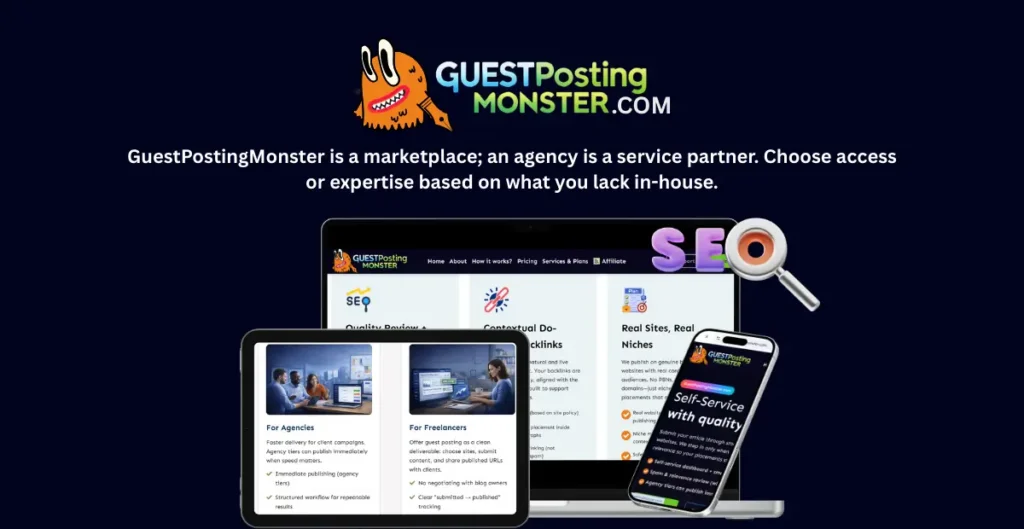
Tech News & Insights
GuestPostMonster vs. Traditional Agencies: The Battle of Platforms and Middlemen in Link Building
GuestPostingMonster and similar direct platforms are challenging the long-held dominance of traditional agencies in the quest for quality backlinks, setting the stage for a pivotal industry confrontation. This essential clash between modern Platforms vs. Middlemen forces every digital marketer into a critical strategic decision. Your choice will directly influence your budget efficiency, operational control, and the scale of your SEO outcomes. Understanding the core strengths and trade-offs of each model is the first step to crafting a superior link-building strategy.
GuestPostingMonster vs. Traditional Agencies: Decoding the Platform and Middleman Paradigms
In today’s frenetic digital marketing landscape, the quest for authoritative backlinks via guest posting often funnels brands into a critical choice: leveraging a direct-access platform like GuestPostingMonster or engaging the seasoned hands of Traditional Agencies. This debate, fundamentally a clash between Platforms vs. Middlemen, is reshaping how SEOs and content strategists allocate budgets and build link equity. Understanding the nuanced battleground between self-service efficiency and full-service management isn’t just tactical—it’s essential for sustainable organic growth.
The High-Stakes World of Modern Link Building
The scene is familiar. Your content is polished, your keywords are targeted, but your site languishes on page two. The diagnosis? A weak backlink profile. In response, a multi-billion dollar link-building ecosystem has erupted, with guest posting at its reputable core. But here’s where the path diverges dramatically. For years, traditional agencies have acted as the gatekeepers, their account managers and negotiated relationships forming a veil between you and the publisher.
Enter the new wave: platforms like GuestPostingMonster, which promise to tear down that veil, offering a dashboard-driven, direct marketplace. This isn’t merely a vendor choice; it’s a philosophical one about control, transparency, speed, and ultimately, who holds the keys to your SEO kingdom. The emotional pull is real—frustration with opaque agency reporting versus the anxiety of navigating a platform’s vast unknowns.
Core Concepts in the Platform vs. Agency Ecosystem
To choose wisely, we must dissect the operational DNA of both models. This isn’t about which is universally “better,” but which aligns with your team’s expertise, resources, and risk tolerance.
The Anatomy of a Direct-Access Platform (e.g., GuestPostingMonster)
Imagine a stock exchange, but for guest posts. Platforms like GuestPostingMonster aggregate hundreds or thousands of websites (publishers) willing to accept content. As a buyer, you gain direct access to a searchable inventory. You can typically filter by metrics like Domain Rating (DR), traffic, niche, and price. The transaction is standardized: you see a site, you pay the listed price, you submit your content following the publisher’s guidelines, and the platform facilitates the process. The value proposition is transparency and scale. You see exactly what you’re buying, upfront. The model empowers proactive SEOs who have strong content creation capabilities and the time to manage the outreach and placement process internally. It turns link building from a bespoke service into a more commoditized, self-serve procurement task.
The Enduring Framework of a Traditional SEO Agency
A traditional agency operates as a service-based middleman. You hire them not just for access, but for their expertise, relationships, and labor. Their process is consultative. They begin with an audit, then develop a strategy, and their team uses their cultivated network of publisher contacts—often built over years—to pitch and place your content. You’re not browsing a menu; you’re paying for a chef’s tasting menu where they handle the sourcing, preparation, and presentation. This includes ideation, writer assignment, outreach, negotiation, placement, and reporting. The cost is significantly higher, but it bundles the entire workflow into a managed service. The agency absorbs the headache of follow-ups, rejections, and relationship management, acting as a true extension of your marketing department.
Strategic Implementation: Choosing Your Path
Your decision should be a strategic one, not a coin toss. Follow this expert framework to align your choice with your business reality.
First, conduct a brutal self-assessment. Do you have an in-house content writer who can produce publisher-ready, expert-level articles? If not, a platform leaves you with a product (access) but no one to build the product (content). What is your team’s bandwidth? Platform management is time-intensive—researching sites, evaluating them beyond surface metrics, crafting personalized pitches (even within a platform), and handling correspondence. An agency offloads this operational burden.
Second, define your campaign’s primary KPI. Is it purely link volume within a strict budget? A platform may offer more links per dollar. Is it brand alignment and authority in specific, high-value publications? An agency’s curated relationships might be indispensable for breaking into tier-1 niches. For a new site needing a foundational link base, platforms can be efficient. For an established brand protecting its reputation while seeking elite placements, an agency’s vetting and negotiation are critical.
Finally, consider the learning curve and desired involvement. Platforms offer a fantastic education in the direct mechanics of link building. You’ll learn what publishers truly want. Agencies offer strategic partnership and time reclamation. The advanced play? Some large organizations use a hybrid model: agencies for core, high-authority link targets and platforms for scalable, tactical supplementation.
Critical Pitfalls and Corrective Measures
Mistake 1: Platform Pitfall – Chasing Metrics Blindly.
On a platform, it’s easy to sort by highest Domain Rating and buy impulsively. This leads to links from high-DR sites in irrelevant niches (e.g., a fintech link on a pet blog), which Google’s algorithms increasingly disregard.
The Correction: Filter by relevance first. Then, conduct due diligence. Use tools to check the site’s real traffic (not just DR), examine its existing content quality, and assess its editorial standards. A link from a DR 50 site in your exact niche is infinitely more valuable than a DR 80 site in an unrelated field.
Mistake 2: Agency Assumption – Assuming “Set and Forget.”
Hiring an agency doesn’t absolve you of oversight. A common error is accepting vague reporting like “10 links placed” without scrutiny.
The Correction: Establish a rigorous reporting protocol upfront. Demand details: the target URL, the published URL, the referring domain’s true relevance, and the content’s alignment with your brand voice. A good agency will provide this willingly. Your role shifts from operator to strategist and auditor.
Mistake 3: Universal Pitfall – Neglecting Content Quality.
Both models fail if the content is transactional garbage. Google’s “Link spam update” and the rise of E-E-A-T target low-value, purely placement-driven content.
The Correction: Whether you’re using a platform or an agency, insist on content that demonstrates Experience, Expertise, Authoritativeness, and Trustworthiness. Provide unique insights, data, or perspectives. The article must genuinely serve the publisher’s audience first; the link is a byproduct of value, not the sole purpose.
Real-World Scenarios and Outcomes
Case Study 1: The Scaling DTC Startup
A direct-to-consumer skincare brand with a nimble in-house marketing team needed to build 50+ contextually relevant links in 6 months to support a new product launch. Their budget was limited but they had a talented content creator. Choice: They used GuestPostingMonster (platform). Action: They meticulously filtered for beauty, wellness, and lifestyle sites with traffic over 10k monthly visits. They crafted exceptional, data-driven content about skincare ingredients. Result: They secured 55 placements at an average cost 60% lower than agency quotes. Their organic visibility for mid-funnel keywords rose by 45%. The key was their internal capability to execute the content piece of the platform’s access.
Case Study 2: The Established B2B SaaS Company
A B2B software company in the cybersecurity space needed to build authority and secure placements in 5-7 elite industry publications (e.g., Dark Reading, CSO Online). Their internal team had no contacts in this niche press. Choice: They hired a specialized B2B SEO agency (traditional middleman). Action: The agency leveraged its editor relationships, co-developed whitepaper-level content with the company’s CTO, and managed the entire pitching and revision process. Result: They secured 6 placements in tier-1 target publications over 8 months. These links were not just for DR; they drove direct referral traffic from industry leaders and significantly boosted the brand’s perceived authority, aiding their enterprise sales cycle.
Case Study 3: The Hybrid Model in Action
An e-commerce brand in the home goods sector used an agency for their primary link-building strategy but noticed a gap in acquiring links from regional interior design blogs and smaller decor magazines. Tasking their expensive agency with these smaller targets was inefficient. Choice: They supplemented with a platform. Action: The agency continued to target major home and garden publications. Meanwhile, a junior SEO on their team used a platform to identify and secure 20+ placements on smaller, highly-relevant regional and niche sites. Result: They achieved a diversified link profile with top-tier authority links and a healthy, scalable layer of supportive mid-tier links, all within a controlled overall budget.
The Future of Link Acquisition: Intelligence and Integration
The battle between platforms and middlemen is moving toward a synthesis. The future belongs to intelligent platforms that offer more than just a listing—they will incorporate deeper quality signals (like traffic trends, audience demographics, and spam scores) and AI-driven relevance matching. Conversely, traditional agencies will be forced to adopt platform-like transparency in their reporting, using dashboards that show clients the potential inventory and placement progress in near real-time.
The rise of “gated” or “vetted” platforms is also imminent, where publishers are more rigorously screened, blurring the line between agency curation and platform scale. Furthermore, as Google’s algorithms grow more sophisticated at valuing link context and audience alignment, the winning model will be whichever one most reliably secures editorially earned links in genuinely relevant contexts, regardless of the procurement method. Smart marketers will prepare by developing internal skills to evaluate link opportunities (platform literacy) while also knowing when to invest in high-touch partnership (agency management).
The Final Verdict for Strategic Marketers
The dichotomy is false. GuestPostingMonster and its platform peers are not the “killers” of traditional agencies, nor are agencies the obsolete relics in the face of automation. They are different tools for different jobs, and for different stages of a business’s growth. The real battle isn’t between the models themselves; it’s against the outdated practice of chasing links as a commoditized transaction. Victory lies in a strategy that prioritizes audience relevance and content excellence above all. Choose a platform when you have the internal resources to act as your own agency. Choose an agency when you need their expertise, relationships, and labor as a force multiplier. Your most powerful asset in this battle is not the tool you select, but the strategic clarity with which you wield it.