
 SaaS Companies
 Digital & Security
 eCommerce & Payments
 Design & Dev
 Reviews & News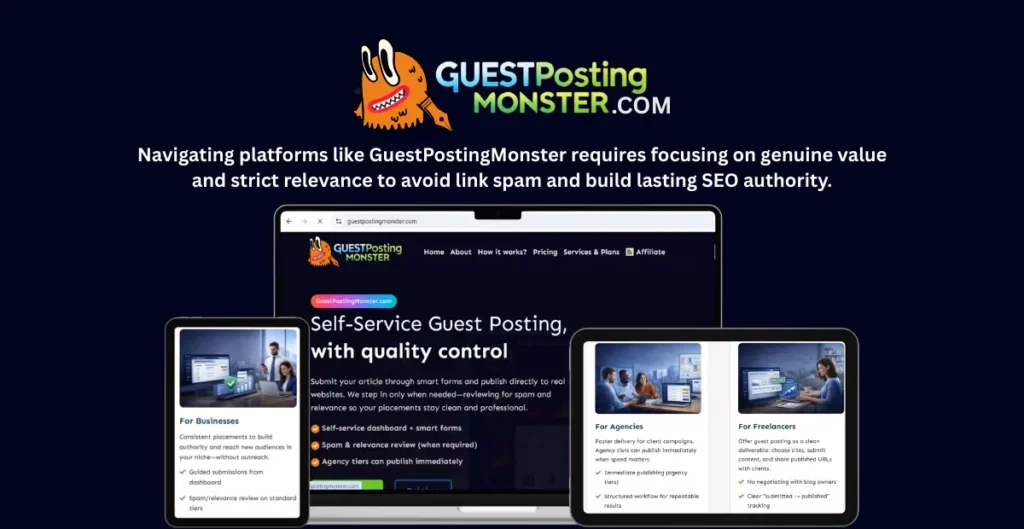
AI & Machine Learning
GuestPostingMonster and Link Spam Safeguards
GuestPostingMonster stands as a prominent platform in the digital marketing arena, connecting writers with publishers to forge valuable backlinks. Yet, its very purpose places it at the heart of a critical industry debate: the relentless fight against manipulative link spam. This article delves into the essential safeguards—from algorithmic defenses to editorial rigor—that determine whether such a platform builds legitimate authority or contributes to the web’s noise, defining the thin line between strategic growth and SEO penalty.
GuestPostingMonster and the Fight Against Link Spam: Navigating the New Guardians of SEO
In the ever-evolving landscape of SEO, the practice of guest posting sits at a critical crossroads, championed by platforms like GuestPostingMonster yet perpetually shadowed by the specter of link spam. For website owners and digital marketers, understanding the safeguards now in place isn’t just academic—it’s the difference between building lasting authority and inviting algorithmic penalty. This isn’t about avoiding a simple slap on the wrist; it’s about navigating a sophisticated ecosystem where quality is relentlessly enforced by both human reviewers and machine learning algorithms. The fight has escalated, and the rules of engagement have been rewritten.
The High-Stakes Game of Modern Link Building
Remember the early days of SEO? It felt like the wild west. A handful of article directory submissions or a bulk purchase of low-quality links could propel a site to the top. That world is gone, dismantled by Google’s relentless updates—Penguin, Panda, and the more recent, sophisticated core updates. The emotional whiplash for businesses that built on that shaky foundation was real. Overnight, traffic vanished, and livelihoods were impacted. This historical context is crucial because it frames our current reality: link spam isn’t just frowned upon; it’s a direct threat to your website’s viability.
Today, link building is a high-stakes game of trust and value. Search engines have shifted from counting links to weighing their merit. A single, powerful link from a respected industry publication can be worth more than a thousand from spammy networks. This is where the narrative gets personal. For the honest business owner investing in genuine marketing, seeing competitors cut corners with spam can be frustrating. But the safeguards are precisely designed to protect that investment, rewarding those who play the long game. Platforms like GuestPostingMonster operate in this tension, aiming to facilitate legitimate connections while the digital sentinels stand watch.
Core Concepts: Demystifying the Guardians and the Threats
To navigate this terrain effectively, we must first understand the key players and mechanisms at work. This isn’t about fear-mongering; it’s about empowerment through knowledge. The ecosystem is defined by two interconnected forces: the sophisticated systems policing link quality and the evolving platforms that facilitate legitimate outreach.
The Anatomy of Modern Link Spam Detection
Google’s algorithms have moved far beyond simple pattern matching. They now employ a multi-layered approach to identify and neutralize link spam:
-
Natural Language Processing (NLP): Algorithms can understand the context and topic of a linking page. A link from a dental blog to a cryptocurrency site will raise red flags, even if the anchor text seems “perfect.”
-
Link Graph Analysis: Google maps the entire web of links. Spam networks have distinct, recognizable signatures—unnatural linking patterns, interconnected sites with low authority, and sudden spikes of inbound links from unrelated sources. These patterns are like fingerprints.
-
Behavioral and Temporal Signals: How are links acquired? A natural link earns mentions over time. Spam links often arrive in huge, artificial bursts. The timing and source behavior are critical signals.
-
Manual Action Teams: Beyond algorithms, Google employs thousands of human quality raters. Their guidelines inform the AI, and they can manually penalize sites engaged in egregious link schemes, a powerful safeguard against those who think they can outsmart a machine.
The Role of Facilitation Platforms like GuestPostingMonster
Platforms such as GuestPostingMonster are not search engines; they are marketplaces or connectors. Their survival depends on aligning with search engine guidelines. Therefore, the most reputable platforms bake-in their own safeguards:
-
Vetting of Publishers: They curate their lists, often verifying site metrics (like Domain Rating or traffic) and ensuring sites have genuine editorial standards, not just a “submit article” page.
-
Content Quality Guidelines: Many enforce rules against overly promotional content, requiring that submissions provide real educational or informational value to the publisher’s audience.
-
Transparency in Linking: They often discourage exact-match commercial anchor text abuse, advocating for natural, contextual links that benefit the reader.
-
Disclosure and Authenticity: Ethical platforms encourage or require disclosure of guest post relationships, fostering the transparency that search engines reward.
A Strategist’s Framework for Safe and Effective Guest Posting
Forget spray-and-pray. Your strategy must be surgical. Here is a step-by-step framework I use with clients to secure links that pass every safeguard and build real equity.
1. The Publisher Audit (Beyond DA/DR): Before even reaching out, conduct a deep audit. Don’t just look at Domain Authority. Check: Is the site actively publishing original content? Are existing guest posts from real people in your industry? Scan the comment sections for genuine engagement. Use tools like Moz or Ahrefs to view the site’s own backlink profile—if it’s built on spam, your link there is worthless.
2. The Value-First Pitch: Your outreach should never start with a request for a link. It must start with an offer of value. Study the publisher’s content gaps. Identify a topic their audience cares about that you can uniquely address. Your pitch should briefly showcase your expertise and present a clear, compelling outline that serves their readers first.
3. Content Creation as a Partnership: Write the article for the publisher’s audience, not your own sales page. The link back to your site should be a natural, logical next step for the reader—perhaps to a deeper resource, a relevant case study, or a foundational tool. Avoid forced anchor text. Use branded terms (your company name) or natural phrases like “as discussed in our guide.”
4. The Relationship Continuum: A one-off guest post is a transaction. A relationship is an asset. If your content performs well for them, offer to write again, or to share their work with your network. This organic relationship is the ultimate safeguard, making future collaborations effortless and inherently natural in the eyes of algorithms.
Common Pitfalls That Still Trigger Penalties (And How to Steer Clear)
Even with good intentions, marketers fall into traps that flag their efforts as link spam.
-
Mistake 1: The “Relevancy” Illusion. Assuming a site in your broad niche is relevant enough. A “business marketing” blog might have a section on health supplements—a link from that section to your supplement site is contextually irrelevant and risky.
-
Correction: Drill down to page-level relevance. The specific article topic and its immediate context are all that matter.
-
-
Mistake 2: Over-Optimizing Author Bios. Stuffing your author bio with multiple keyword-rich links back to commercial pages is a glaring red flag.
-
Correction: Keep bios clean. One link to your site’s homepage or a dedicated “about” page is sufficient. Use your name or company as anchor text.
-
-
Mistake 3: Ignoring the Site’s Link Velocity. A site that suddenly publishes 50 guest posts a month is not a quality hub. It’s a link farm, regardless of its domain metrics.
-
Correction: Use the Wayback Machine and archive checks to see how the site’s publishing volume has changed. A sudden, dramatic increase in guest content is a major warning sign.
-
-
Mistake 4: Neglecting the “Neighborhood.” As the old saying goes, you’re judged by the company you keep. If the site links out to other spammy or penalized resources, your link is in bad company.
-
Correction: Manually check a sample of their outbound links. Are they directing readers to authoritative sources, or to a sea of low-quality product pages?
-
Real-World Scenarios: The Good, The Bad, and The Recovered
Case Study 1: The SaaS That Scaled with Context
A B2B SaaS company in the project management space used a platform like GuestPostingMonster not to find “any” blog, but specifically to identify niche industry blogs for engineering managers and product leads. They pitched data-driven articles on team efficiency, linking back naturally to a relevant, non-commercial benchmark report on their site. The safeguard here was extreme topical relevance. Over 18 months, they earned 15 links from highly authoritative niche sites. Their organic traffic for middle-funnel terms grew by 200%, and crucially, they saw zero ranking volatility during core updates.
Case Study 2: The Local Clinic’ Costly Shortcut
A dental clinic wanted to rank faster. They used a cheap link-building service that secured 50+ guest posts on “general health,” “wellness,” and even unrelated business blogs. The anchors were all “best dentist in [city].” This created an utterly unnatural link graph. A Google manual action hit, wiping them from the top 100 for all key terms. The recovery took 8 months: a laborious process of using the Disavow Tool for the worst links, creating truly remarkable local content to earn genuine mentions, and submitting a detailed reconsideration request. The safeguards (algorithmic and manual) worked precisely as intended.
Case Study 3: The Publisher’s Dilemma
A legitimate industry news site accepted guest posts to broaden perspectives. They lacked strong editorial safeguards. Soon, they were inundated with low-quality submissions. Their site became a conduit for link spam, and Google’s algorithms devalued the entire domain’s link equity, hurting the rankings of their own original journalism. Their solution was to implement a strict editorial process, requiring expert credentials and original research for guest contributors, turning a vulnerability into a mark of prestige.
The Future of Link Building: AI, Authenticity, and Advanced Safeguards
The arms race will intensify, but the direction is clear. AI will play a dual role. On one side, spammers will use AI to generate low-quality content at scale. On the other, search engines will use even more advanced AI to detect the lack of human experience, nuance, and genuine insight in that content—the very essence of E-E-A-T.
-
Entity-First Indexing: Google will move further from analyzing pages to understanding entities (brands, people, concepts) and their relationships. A link’s power will be tied to the authoritative entity (the writer, the publication) behind it.
-
Brand Signals as a Primary Safeguard: Mere mentions without links may gain more weight if they occur in authoritative contexts. The focus will be: “Is this brand a recognized, discussed entity in its field?” Guest posting will need to fuel this brand recognition cycle.
-
Platform Accountability: Middleman platforms like GuestPostingMonster will face pressure to provide more transparency—perhaps publishing their own publisher vetting criteria or adopting standardized trust seals. Their longevity depends on their ability to act as a proactive filter, not just a passive directory.
Smart marketers will stop asking, “How do I get a link?” and start asking, “How do I become the inevitable citation on this topic?” This shifts the focus from building links to building undeniable, citable authority.
Your Blueprint for Sustainable Authority
The fight against link spam has fundamentally reshaped guest posting from a tactical game into a strategic imperative. The safeguards in place—both algorithmic and human—are not obstacles for the legitimate marketer; they are protective barriers that ensure your hard work isn’t undermined by those cutting corners. Platforms like GuestPostingMonster are tools, and like any tool, their effectiveness is determined by the craftsman’s skill and intent.
Your ultimate safeguard is your own judgment. Does this collaboration feel authentic? Would you share this article with a colleague even if the link were removed? Does it enhance your brand’s reputation? If the answer is yes, you’re not just building a link; you’re building a digital asset that can withstand any algorithm update. In this new era, quality isn’t just king—it’s the entire kingdom. Build yours wisely.