
 SaaS Companies
 Digital & Security
 eCommerce & Payments
 Design & Dev
 Reviews & News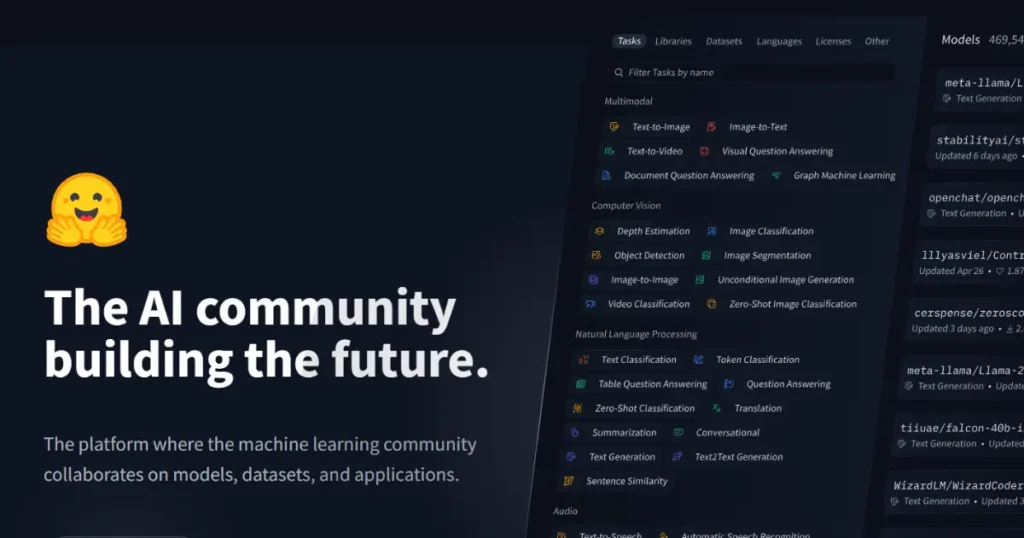
AI & Machine Learning, AI Agencies
What Hugging Face is?
Hugging Face is an artificial intelligence platform focused on making machine learning models, datasets, and experimentation tools accessible to developers, researchers, and companies. It is widely known for providing a centralized ecosystem where AI practitioners can discover, reuse, and collaborate on machine learning components instead of building everything from scratch.
Hugging Face Platform Overview
Hugging Face operates as a combination of a model repository, dataset hosting service, and machine learning tooling ecosystem. At its core is the Hugging Face Hub, which functions similarly to a version-controlled library for AI assets. The platform is used across academia, startups, and enterprise environments for both experimentation and production workflows.
Unlike single-purpose AI tools, Hugging Face does not focus on one application such as chatbots or image generation alone. Instead, it supports a broad range of machine learning tasks, including natural language processing, computer vision, audio processing, and multimodal applications.
Hugging Face Models and Model Hosting
Hugging Face provides hosting for hundreds of thousands of machine learning models contributed by individuals, research labs, and companies. These models cover tasks such as text classification, summarization, translation, question answering, speech recognition, image classification, and generative AI.
Each Hugging Face model page typically includes:
-
Model architecture information
-
Intended use cases
-
Training details and limitations
-
Example code snippets
-
Version history
This structure allows developers to evaluate whether a model fits their needs before integrating it into a project. Models can be public or private, making Hugging Face suitable for open research as well as internal enterprise use.
Hugging Face Datasets and Data Management
Hugging Face also hosts a large collection of datasets used for training and evaluating machine learning models. These datasets range from small curated sets to large-scale corpora used in research and production.
The dataset system includes:
-
Versioning and updates
-
Metadata and documentation
-
Preview and filtering tools
-
Programmatic access through APIs
By standardizing how datasets are stored and accessed, Hugging Face simplifies reproducibility and collaboration across teams.
Hugging Face Transformers Library
One of the most widely used components of Hugging Face is the Transformers library. This open-source library provides standardized implementations of modern machine learning architectures, especially transformer-based models.
The Hugging Face Transformers library enables developers to:
-
Load pretrained models with minimal configuration
-
Fine-tune models on custom datasets
-
Run inference across multiple frameworks
-
Export models for deployment
This library acts as the execution layer that connects models from the Hub with real-world applications.
Hugging Face Spaces and Interactive Demos
Hugging Face Spaces allow users to build and host interactive demos for machine learning models directly in the browser. These demos can be used for internal testing, public showcases, or collaborative experimentation.
Common uses of Hugging Face Spaces include:
-
Demonstrating how a model behaves with live inputs
-
Sharing proof-of-concept AI applications
-
Allowing non-technical stakeholders to test models
Spaces support popular frameworks and provide an accessible way to validate ideas before committing to full development.
Hugging Face Use Cases in Real Projects
Hugging Face is commonly used in workflows such as:
-
Rapid prototyping of AI features
-
Model benchmarking and comparison
-
Research publication and reproducibility
-
Internal AI tooling and experimentation
-
Educational and learning environments
Because Hugging Face emphasizes modularity, teams often integrate it into larger systems rather than using it as a standalone product.
Hugging Face for Teams and Enterprises
Beyond individual users, Hugging Face offers features designed for teams, including:
-
Private repositories for models and datasets
-
Access controls and collaboration tools
-
Scalable inference options
-
Enterprise support and security features
This makes Hugging Face suitable for companies that want to manage AI assets in a controlled and auditable way.
Hugging Face Limitations and Considerations
While Hugging Face provides powerful infrastructure, it is not a turnkey AI solution. Teams still need:
-
ML expertise to select and fine-tune models
-
Infrastructure planning for large-scale deployment
-
Evaluation and monitoring processes
Hugging Face works best as part of a broader AI stack rather than a replacement for engineering workflows.