
 SaaS Companies
 Digital & Security
 eCommerce & Payments
 Design & Dev
 Reviews & News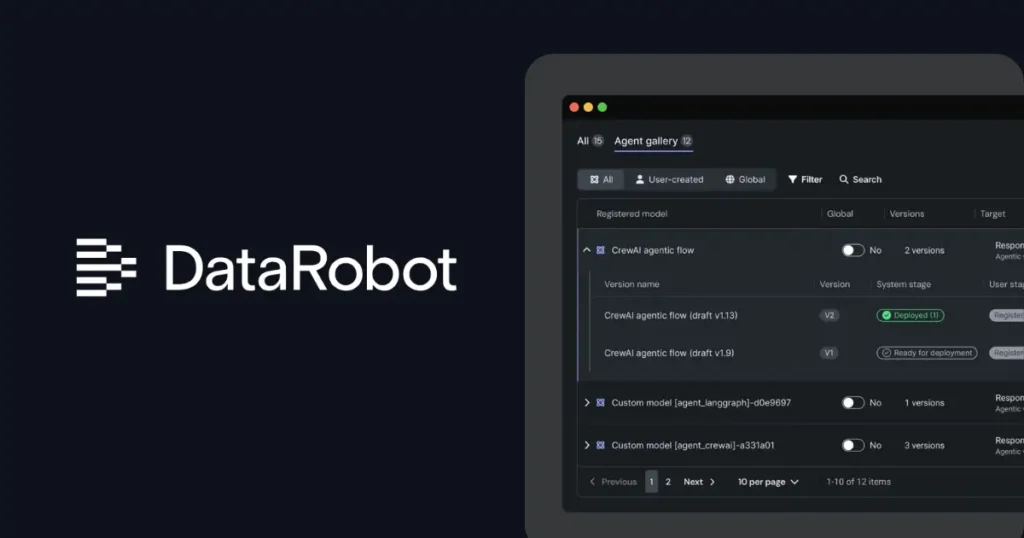
AI & Machine Learning, AI Agencies, Cloud Computing
How the DataRobot Platform Builds and Manages AI Models
DataRobot is an artificial intelligence platform focused on automating and operationalizing machine learning for businesses. DataRobot is designed to help organizations build predictive and generative AI models faster by handling many of the complex steps involved in data preparation, model training, evaluation, deployment, and monitoring.
DataRobot Platform Overview
DataRobot provides an end-to-end environment where data scientists, analysts, and engineering teams can work together to create and manage machine learning systems. Instead of requiring users to manually test dozens of algorithms and configurations, DataRobot automates much of this process while still allowing advanced users to customize models when needed.
The DataRobot platform is commonly used by organizations that want to apply AI to real business problems without building a full machine learning infrastructure from scratch.
DataRobot Automated Machine Learning Capabilities
DataRobot is best known for its automated machine learning (AutoML) functionality. This capability allows users to train and compare many different models automatically using a single dataset.
With DataRobot AutoML, the platform:
-
Tests multiple algorithms in parallel
-
Tunes hyperparameters automatically
-
Evaluates models using standardized metrics
-
Ranks models based on performance and stability
This approach helps teams quickly identify models that perform well without extensive manual experimentation.
DataRobot Data Preparation and Feature Engineering
DataRobot includes tools that assist with data preparation and feature engineering, which are critical steps in any machine learning project. These tools help users transform raw data into formats suitable for modeling.
DataRobot data preparation features commonly include:
-
Automatic detection of data types
-
Handling of missing or inconsistent values
-
Feature transformations and encoding
-
Time series preparation for forecasting tasks
By standardizing these steps, DataRobot reduces the time required to move from raw data to usable models.
DataRobot Model Training and Evaluation
Once data is prepared, DataRobot manages the training and evaluation of models. The platform generates multiple candidate models and provides detailed performance reports for each one.
DataRobot evaluation tools typically show:
-
Accuracy and error metrics
-
Cross-validation results
-
Feature importance explanations
-
Model stability over time
These insights help teams understand why a model performs the way it does and whether it is suitable for production use.
DataRobot Deployment and Inference
DataRobot supports deploying machine learning models into production environments where they can generate predictions in real time or in batches. Deployment options are designed to integrate with existing systems and applications.
Common DataRobot deployment patterns include:
-
Real-time prediction APIs
-
Batch scoring for large datasets
-
Integration with business applications
-
Scalable infrastructure for variable workloads
These options allow organizations to move from experimentation to real-world usage efficiently.
DataRobot MLOps and Model Monitoring
Managing models after deployment is a major challenge in machine learning. DataRobot addresses this through built-in MLOps features that help teams monitor and maintain models over time.
DataRobot MLOps capabilities include:
-
Tracking model performance in production
-
Detecting data drift and prediction drift
-
Managing model versions and replacements
-
Alerting teams when models degrade
These features help ensure that models remain accurate and reliable as data and business conditions change.
DataRobot Explainability and Governance
DataRobot places strong emphasis on model explainability and governance. The platform provides tools that help users understand how models make decisions, which is important for trust and compliance.
DataRobot explainability features often include:
-
Feature impact and contribution analysis
-
Transparent model documentation
-
Audit trails for model changes
-
Support for regulated industries
This focus makes DataRobot suitable for sectors such as finance, healthcare, and insurance, where transparency is critical.
DataRobot Use Cases Across Industries
DataRobot is applied across many industries and business functions, including:
-
Sales forecasting and demand planning
-
Fraud detection and risk analysis
-
Customer churn prediction
-
Marketing optimization and personalization
-
Operational efficiency and process automation
Because DataRobot supports both predictive and generative AI workflows, it can adapt to a wide range of organizational needs.
DataRobot Limitations and Practical Considerations
While DataRobot simplifies many aspects of machine learning, organizations must still plan carefully. Important considerations include:
-
Ensuring high-quality input data
-
Understanding model assumptions and limitations
-
Managing costs for large-scale deployments
-
Aligning AI initiatives with business goals
DataRobot is most effective when used by teams that combine domain knowledge with structured AI workflows.