
 SaaS Companies
 Digital & Security
 eCommerce & Payments
 Design & Dev
 Reviews & News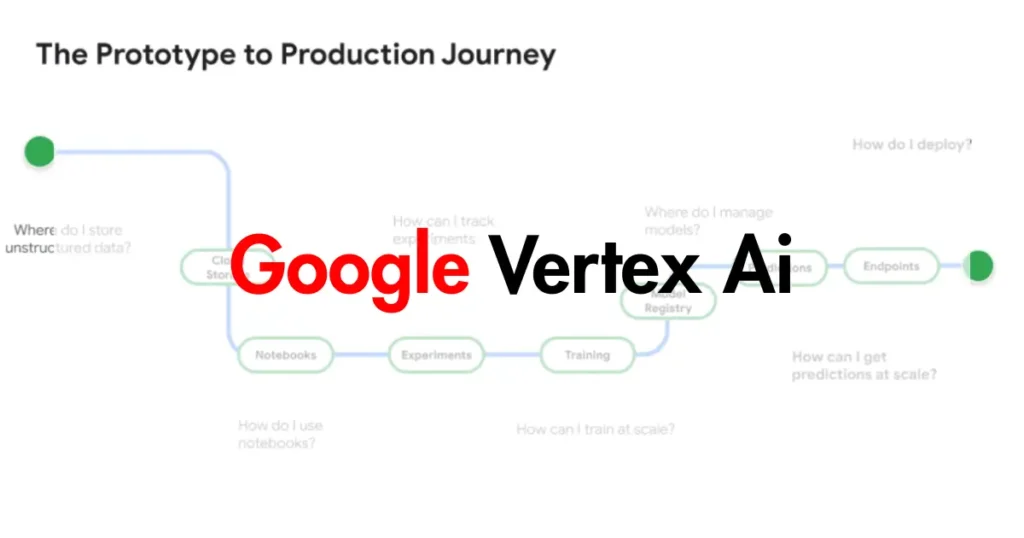
AI & Machine Learning, AI Agencies, Cloud Computing
Google Vertex AI
Google Vertex AI is a managed machine learning platform provided by Google Cloud that helps organizations build, train, deploy, and scale machine learning and generative AI models using a unified workflow. Google Vertex AI is designed to bring together data preparation, model development, and production deployment into a single system, reducing fragmentation across tools and services.
Google Vertex AI Platform Overview
Google Vertex AI serves as Google Cloud’s centralized environment for machine learning and artificial intelligence workloads. Instead of requiring teams to switch between separate services for training, experimentation, and deployment, Google Vertex AI combines these stages into a cohesive platform. This approach is intended to simplify both traditional machine learning projects and newer generative AI use cases.
The platform is used by startups, enterprises, and research teams that want to operationalize machine learning without managing infrastructure manually.
Google Vertex AI Model Development Capabilities
Google Vertex AI supports multiple approaches to model development, allowing teams with different levels of expertise to work within the same system. Users can choose between automated solutions and fully custom training workflows.
Google Vertex AI model development options include:
-
AutoML for building models with minimal manual configuration
-
Custom training using popular frameworks such as TensorFlow and PyTorch
-
Pretrained foundation models accessible through managed services
-
Experiment tracking and version control
This flexibility allows organizations to start simple and gradually adopt more advanced techniques as their needs evolve.
Google Vertex AI Generative AI and Foundation Models
Google Vertex AI provides access to foundation models for tasks such as text generation, summarization, image understanding, and multimodal applications. These models can be used directly through APIs or customized with organization-specific data.
Common generative AI use cases with Google Vertex AI include:
-
Conversational assistants and chat interfaces
-
Content generation and rewriting workflows
-
Document analysis and summarization
-
Knowledge-based question answering systems
By offering managed access to these models, Google Vertex AI reduces the complexity of deploying generative AI at scale.
Google Vertex AI Training and Compute Infrastructure
Training machine learning models often requires significant computational resources. Google Vertex AI handles this by automatically provisioning and scaling compute resources based on the job configuration.
Key Google Vertex AI training features include:
-
Managed training jobs with scalable compute
-
Distributed training for large datasets
-
GPU and TPU support
-
Cost controls through job scheduling and resource management
This managed infrastructure allows teams to focus on experimentation and performance rather than hardware management.
Google Vertex AI Deployment and Serving
Once a model is ready, Google Vertex AI provides multiple options for deployment and inference. These options are designed to support both real-time applications and large-scale batch processing.
Google Vertex AI deployment features include:
-
Online prediction endpoints for low-latency inference
-
Batch prediction for processing large datasets
-
Automatic scaling to handle variable traffic
-
Model versioning and rollback capabilities
These features help ensure that models can be updated and maintained without disrupting production systems.
Google Vertex AI MLOps and Lifecycle Management
Google Vertex AI includes tools that support machine learning operations (MLOps), helping teams manage models throughout their lifecycle. This includes tracking experiments, approving models, and monitoring performance after deployment.
Google Vertex AI MLOps capabilities include:
-
Model registry and governance workflows
-
Continuous training pipelines
-
Performance and data drift monitoring
-
Integration with CI/CD systems
These tools are particularly valuable for organizations running machine learning in regulated or mission-critical environments.
Google Vertex AI Integration with Google Cloud Services
A major advantage of Google Vertex AI is its integration with other Google Cloud services. It is often used alongside:
-
BigQuery for large-scale data analysis
-
Cloud Storage for dataset management
-
Cloud Functions and Cloud Run for application logic
-
Identity and access management for security
This integration allows Google Vertex AI to act as the machine learning backbone within broader cloud architectures.
Google Vertex AI Use Cases Across Industries
Google Vertex AI is used across industries such as:
-
Retail and e-commerce for demand forecasting and personalization
-
Finance for risk analysis and anomaly detection
-
Healthcare for data analysis and research support
-
Media and content platforms for recommendation and classification
Its versatility makes Google Vertex AI suitable for both experimental projects and production-grade AI systems.
Google Vertex AI Limitations and Considerations
While Google Vertex AI simplifies many aspects of machine learning, teams must still plan carefully. Important considerations include:
-
Managing costs for large-scale training and inference
-
Ensuring data quality and proper feature engineering
-
Monitoring models for accuracy and bias over time
-
Aligning AI workflows with organizational compliance requirements
Google Vertex AI works best when paired with clear objectives and well-structured data pipelines.